
Beautiful Plants For Your Interior

Check yourself for dehydration using three markers together: morning body weight, urine colour and thirst. Meeting two of the three flags dehydration reliably, while the skin-pinch test is largely unreliable in adults.
Some links below are affiliate links. If you buy through them we may earn a commission at no extra cost to you. See our Affiliate Disclosure.
To check yourself for dehydration, use three markers together rather than any single one: your morning body weight, the colour of your urine, and how thirsty you feel. If you have lost more than 1% of your normal morning weight, your urine is darker than a pale straw colour, and you feel noticeably thirsty, you are very likely dehydrated. Research suggests that meeting any two of those three markers is enough to flag dehydration with reasonable confidence — while relying on just one of them, or on the old skin-pinch test, will often mislead you.
That combination approach has a name in the sports-science literature: the WUT method, short for weight, urine colour and thirst. Below is how to run each check properly, what the thresholds actually are, which popular tests are close to useless in adults, and when a self-check is not enough.
The WUT model works because each marker fails in a different way. Body weight is precise but easily thrown off by a meal. Urine colour is convenient but can be stained by supplements. Thirst is instant but arrives late. Stack them and the errors tend to cancel out.
A 2023 study in the British Journal of Nutrition tested the method against laboratory hydration markers — urine specific gravity, urine osmolality and plasma osmolality — at both morning and afternoon time points. When two or three WUT markers were met, specificity was high across the board: 0.890–1.000 against urine specific gravity, 0.869–1.000 against urine osmolality, and 0.787–0.990 against plasma osmolality. In plain terms, when two or three markers line up, it is unlikely you are being told you are dehydrated when you are not.
The published thresholds are specific, and worth using as written:
Two of three means you are likely dehydrated. All three means very likely. One marker on its own is not enough — the researchers were explicit that no single marker provides sufficient evidence by itself.
One caveat worth knowing: this was a small laboratory study of 24 healthy young adults, and the authors noted that the weight component is less trustworthy in the afternoon, once you have eaten and drunk through the day. Weigh yourself in the morning.
Water is heavy. A short-term drop on the scale is mostly fluid, not fat, which makes body weight the closest thing to a real measurement available in a bathroom. Weigh yourself first thing, after using the toilet and before eating or drinking, for three ordinary days to establish your baseline. After that, a morning reading more than 1% below baseline — about 1.7 lb for a 170 lb adult — is a genuine fluid deficit.
This only works with a scale that resolves to a tenth of a pound or 0.1 kg; a cheap analogue scale cannot detect a 1% change. A precision digital bathroom scale is the one piece of kit that makes this method usable.
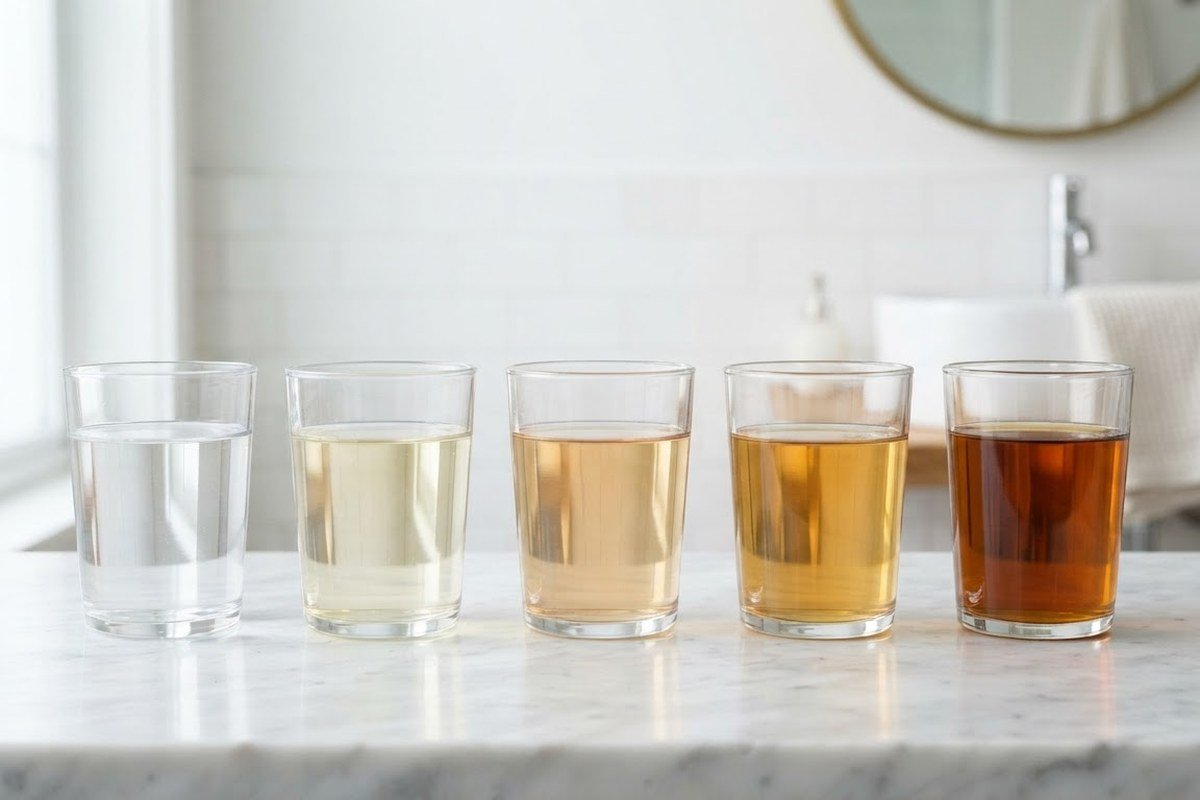
Urine colour has been a validated hydration index since Armstrong’s eight-point chart was published in 1994, and it correlates well with laboratory measures of urine concentration. Pale yellow to light straw is the target. Deep amber or honey-coloured urine means your kidneys are conserving water.
Check it in natural light, in a white bowl, and ignore the first urine of the morning — overnight urine is concentrated in almost everyone and is not a fair test.
Thirst is a real physiological signal, not a myth, but it lags behind the fluid loss that triggers it, and the sensation is blunted in older adults. Treat a thirst rating of 5 or more out of 9 as one vote, not a verdict.
Pinching the skin on the back of the hand and watching it settle back is the test everyone has heard of, and in adults it is the weakest one on this list. Skin loses collagen and elasticity with age, so an older adult’s skin can recoil slowly whether or not they are dehydrated. A review of the evidence found skin turgor was not effective on its own for detecting dehydration in people over 65 — precisely the group most at risk. Clinicians use it as one sign among several, never alone, and you should treat it the same way.
Most well-hydrated adults urinate somewhere in the region of every three to four hours during the day. Going many hours without needing to go, and producing only a small amount when you do, is a reasonable supporting clue. It is a soft signal though — caffeine, medications and bladder conditions all shift it.
Colour is convenient, which is exactly why it gets over-trusted. Several things darken or brighten urine independently of hydration:
Run in the other direction too: urine that is completely colourless all day long is not a gold star. It can mean you are drinking more than you need, and in rare cases — usually during endurance events or with very high intakes over a short period — excessive water intake can dilute blood sodium dangerously. If you want an objective reading rather than a visual judgement, urine specific gravity test strips give you a number instead of an opinion.
Self-assessment is for everyday, mild fluid deficits. Stop testing and seek medical care if you or someone else has any of the following:
Persistent thirst is its own warning sign. Thirst that does not go away no matter how much you drink — especially alongside frequent urination, fatigue or unexplained weight loss — is called polydipsia, and it can be a symptom of undiagnosed diabetes, diabetes insipidus, kidney disease, or a side effect of medication. That is a doctor’s appointment, not a hydration problem. For a fuller look at conditions that imitate dehydration, see our guide to what can be mistaken for dehydration.
There is no universal plain-water number. The Institute of Medicine’s adequate intake figures, which the CDC still points to, are 3.7 litres (125 oz) of total water per day for men and 2.7 litres (91 oz) for women — and critically, that total includes water from food and all other beverages, not just what you drink from a glass. Fruit, vegetables, soup, milk, coffee and tea all count toward it. Your own requirement moves with body size, activity, heat and illness.
Getting this roughly right appears to matter over the long run. An NIH study published in eBioMedicine in 2023, following more than 15,000 adults for over 25 years, found that middle-aged people with serum sodium above 142 mmol/L — used as a proxy for lower fluid intake — had a 39% higher risk of developing chronic disease, and those above 144 mmol/L a 21% higher risk of premature death. This is an observational association rather than proof of cause, but it points the same direction as the rest of the evidence. If you want the day-by-day picture, we cover how long it takes for water to change your body separately.
People who dislike the taste or smell of their tap water drink measurably less of it, and reach for sweetened drinks instead. If that describes you, the hydration fix is a water problem, not a willpower problem. Chlorine taste, sulphur smell and hardness are all treatable, and they vary enormously by region — you can look up your own area on our drinking water quality by state hub.
Before buying any equipment, find out what is actually in your supply — a certified lab test such as Tap Score reports what is present and at what concentration, which is the only sensible basis for deciding whether treatment is worth it at all. And if the real problem is simply that you forget to drink, an insulated bottle with time markings is a low-tech fix that works. For the wider picture, start with our hydration and health guide.
Tracking your morning body weight against a three-day baseline, combined with urine colour and thirst. No single at-home test is reliable alone; the combination is what makes it accurate.
Poorly in adults, and worst in the people most at risk. Skin elasticity declines with age, so slow recoil may reflect age rather than hydration. Evidence reviews have found it ineffective on its own in adults over 65.
Pale yellow to light straw — below 5 on the standard eight-point chart. Darker than that suggests your kidneys are conserving water. Completely clear urine all day may mean you are over-drinking.
Yes. Thirst lags behind fluid loss, and the sensation is blunted in older adults, so it is common to have a measurable deficit before thirst registers. This is exactly why the weight and urine checks matter.
Clinical rehydration protocols generally assess recovery over a 4 to 24 hour window, with the timeline depending on severity and how well fluids are tolerated. Mild everyday dehydration usually resolves within a day of drinking normally.
No. B vitamins, beets, blackberries and some medications all change urine colour independently of hydration. Persistently dark or discoloured urine that you cannot explain is worth raising with a doctor.
Last updated 14 September 2026.
This article is for general information only and is not medical advice. Talk to a qualified healthcare professional about your own situation. See our Health Disclaimer.
