
Beautiful Plants For Your Interior


The American cities with the worst documented water quality in recent years are Jackson, Mississippi, whose system failed so completely in 2022 that a federal court placed it under outside management; Flint, Michigan, site of the most studied lead crisis in U.S. history; and Newark, New Jersey, which spent years above the federal lead action level before an aggressive pipe-replacement program. Close behind are Baltimore and Houston, which both issued major boil-water notices in 2022, and a cluster of communities in California’s Central Valley that have lived with arsenic, nitrate, and 1,2,3-TCP violations for years. “Worst” depends on the yardstick — ongoing violations, lead exposure, or emergency events — so this guide walks through each.
Last updated August 20, 2026. This article is informational only and is not medical advice — see our Health Disclaimer.
Some links below are affiliate links. If you buy through them we may earn a commission at no extra cost to you. See our Affiliate Disclosure.
There is no single official ranking of the worst city water in America, which is why every list you find looks different. The honest way to judge a water system is to look at four kinds of evidence:
With that framework, here are the cities with the strongest documented cases — and what has changed in each since the headlines.
Jackson is the clearest answer to “which city has the worst water” in the 2020s. Decades of deferred maintenance came to a head in August 2022, when flooding overwhelmed the O.B. Curtis treatment plant and roughly 150,000 residents lost reliable running water. Boil-water notices had already been a recurring fact of life there. The failure was severe enough that, in late 2022, the U.S. Department of Justice and EPA intervened and a federal court appointed an interim third-party manager to run the system — an extraordinary step for an American capital city. Rebuilding is underway, but restoring both the infrastructure and residents’ trust is expected to take years. Jackson’s story is part of a broader pattern across the state, which we cover in our guide to Mississippi’s drinking water.
Flint became shorthand for water mismanagement after the city switched its source to the Flint River in 2014 without adequate corrosion control. Lead leached from aging pipes into homes, and the CDC documented elevated blood lead levels in the city’s children. The crisis triggered criminal charges, a massive settlement, and a citywide lead service line replacement effort. Flint’s water has tested below the federal lead action level for years now, but the episode remains the benchmark for how badly things can go — and why corrosion control matters everywhere. For the statewide picture, see our breakdown of Michigan’s drinking water quality.
Newark spent 2017 through 2019 repeatedly exceeding the federal lead action level, at one point distributing bottled water and tens of thousands of filters to residents. The city then did something unusual: it replaced more than 20,000 lead service lines in under three years, one of the fastest replacement programs in the country, and its lead levels have since fallen well below the action level. Newark now gets cited as a recovery model — but its crisis years earn it a place on this list, and New Jersey as a whole still wrestles with PFAS and legacy lead, as we detail in our New Jersey water quality guide.
In September 2022, routine sampling detected E. coli in parts of West Baltimore, triggering a boil-water advisory for tens of thousands of residents. E. coli in treated distribution water is rare and serious, because it signals that fecal contamination reached taps rather than being stopped at the plant. The advisory was lifted within days after flushing and re-testing, but the event exposed the fragility of one of the older distribution networks in the country.
In November 2022, a power failure at a Houston purification plant dropped system pressure below the state’s required minimum, and the fourth-largest city in America spent roughly two days under a citywide boil-water notice. Pressure loss matters because it can let contaminants get pulled into pipes. Houston’s water normally meets federal standards, but the scale of that event — more than two million people — puts it on any recent-problems list. Texas systems large and small appear in our Texas drinking water guide.
No single big city here, but no honest list can skip it: California’s own State Water Board maintains a list of “failing” water systems under its SAFER program, and those systems are heavily concentrated in Central Valley farm communities. The recurring contaminants — nitrate from fertilizer, naturally occurring arsenic, and the industrial fumigant byproduct 1,2,3-TCP — have left some small towns relying on bottled or hauled water for years. It is the largest concentration of chronically out-of-compliance systems in the country. Our California water quality guide covers which regions are affected.
Not necessarily — and this is where most “worst water” lists mislead people. Flint and Newark both test below the federal lead action level today; their crises are historical, though residual risk from any remaining lead plumbing is real. Jackson is genuinely still rebuilding. Baltimore’s and Houston’s events were resolved in days. Meanwhile, a city that has never made a headline can quietly deliver water with legal-but-elevated levels of arsenic, disinfection byproducts, or PFAS. The lesson isn’t “avoid these six cities” — it’s that you should check your own system’s record instead of assuming either the best or the worst. For a state-by-state view, start with our drinking water quality by state hub, and if you’re curious which cities sit at the other end of the spectrum, see our companion guide to the US cities with the cleanest tap water.
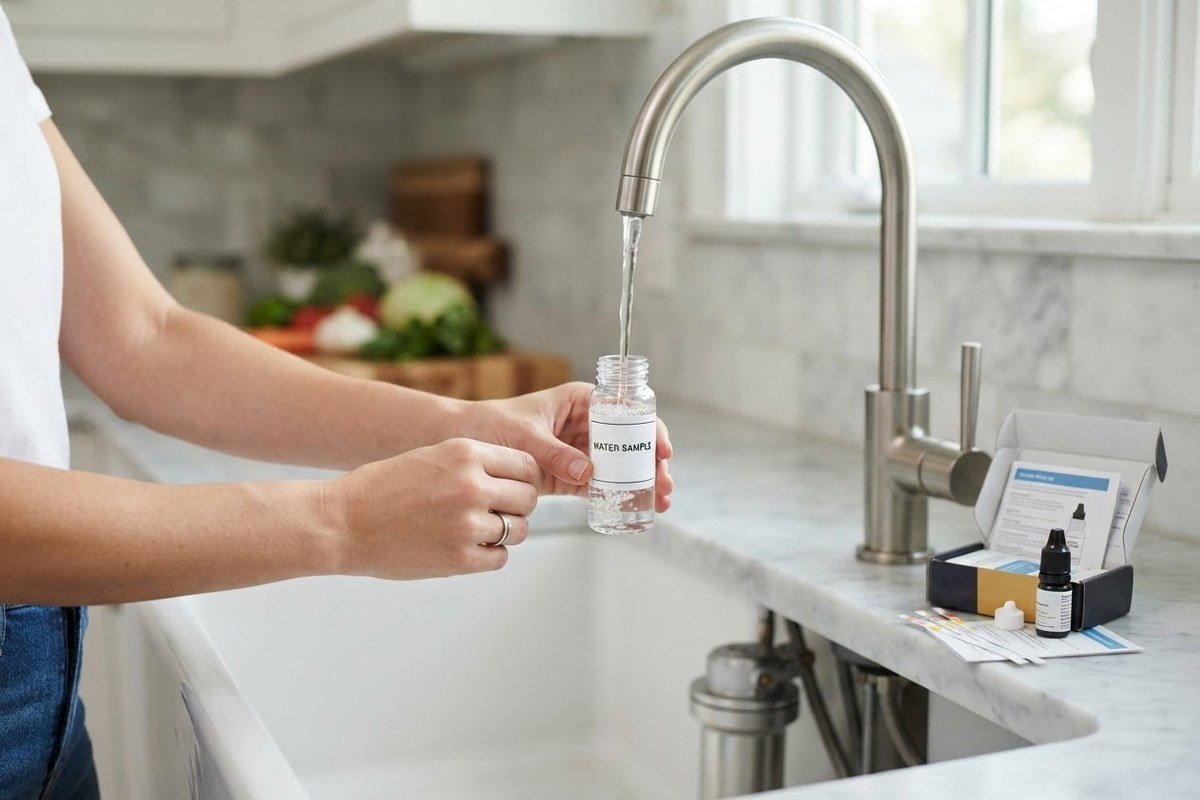
Three steps, all doable in an afternoon:
Match the fix to the documented problem — not to marketing:
Statewide data is useful context, but it’s an average across hundreds of utilities. It can’t tell you about your service line, your building’s plumbing, or a private well. A certified lab test is the only way to know what’s reaching your kitchen.
Based on the documented record, Jackson, Mississippi has the strongest claim — its system failed badly enough in 2022 that a federal court placed it under third-party management, and rebuilding is still in progress. Chronic small-system violations in California’s Central Valley are arguably worse per capita, just spread across many small communities rather than one famous city.
Flint has tested below the federal lead action level for several years, and the city has replaced lead service lines across most of the system. Residual risk remains in homes with lead interior plumbing or fixtures, which is why filters and at-home testing are still recommended there — as they are in any older-housing city.
Check your utility’s annual Consumer Confidence Report, then look the system up in the EPA’s ECHO enforcement database and the EWG Tap Water Database. Between the three, you’ll see legal violations, enforcement history, and contaminants that are legal but above independent health guidelines.
Yes, if you buy the right certification. Look for NSF/ANSI 53 certification for lead and NSF/ANSI 53 or 58 with a PFAS reduction claim for forever chemicals. Reverse osmosis systems certified under NSF/ANSI 58 handle the broadest range, including nitrate and arsenic. An uncertified filter is a guess, not a safeguard.
During an active boil-water notice or do-not-drink order, bottled water is the right short-term call. Long term, bottled water is regulated by the FDA to standards roughly parallel to the EPA’s tap rules, so it isn’t automatically purer — and it costs hundreds of times more per gallon than filtering your own tap.
Because they measure different things: some count EPA violations, some rank lead levels, some use EWG’s stricter health guidelines, and some just recycle old headlines. That’s why this guide separates ongoing failures (Jackson, Central Valley) from resolved crises (Flint, Newark) and one-off emergencies (Baltimore, Houston).
This article is for general information only and is not a substitute for professional medical or public-health advice. If you have concerns about your water or your health, consult your utility, local health department, or physician. See our full Health Disclaimer.
