
Beautiful Plants For Your Interior

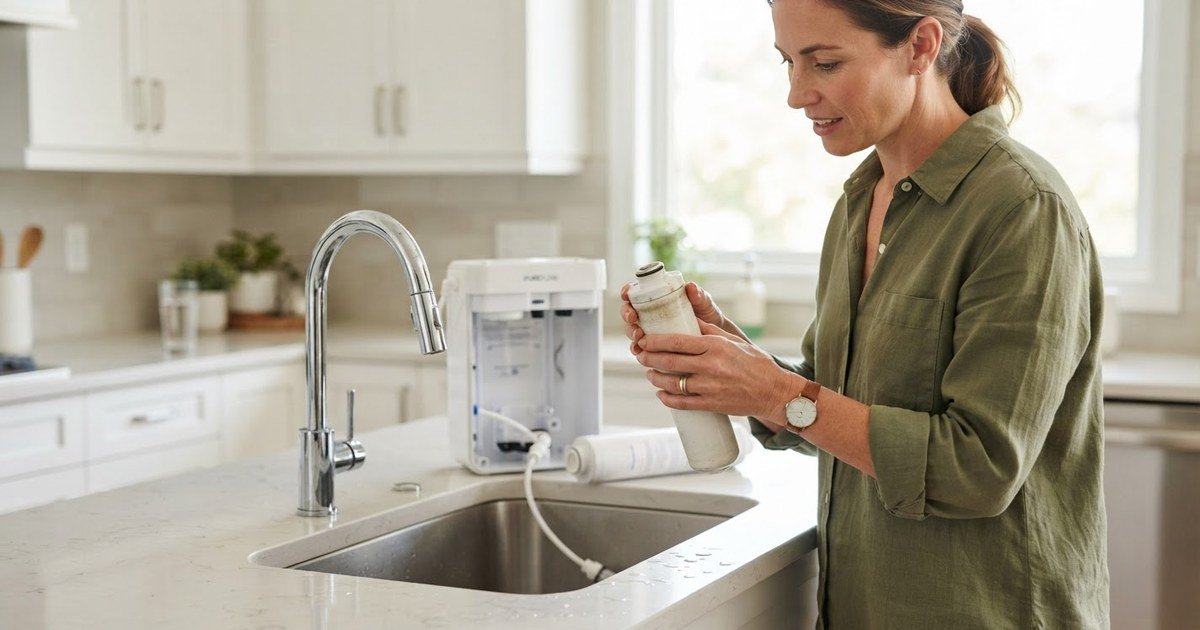
The short answer: replace your water filter when it hits the manufacturer’s rated capacity — the gallon figure or month figure printed on the box — not when it looks dirty. Between those dates, the four reliable warning signs are a noticeable drop in flow rate, the return of a chlorine or musty taste, visible cloudiness or sediment in the glass, and an indicator light or timer that has tripped. A filter that has passed its rated capacity is no longer certified to reduce anything, even if the water still looks and tastes fine.
That last point is the one most people get wrong. Filters do not fail dramatically. They quietly stop doing the job while continuing to produce clear, cold, perfectly normal-looking water. Below are the seven signs worth watching, the realistic replacement intervals by filter type, and the two myths that cause people to either overspend on cartridges or run them far too long.
Some links below are affiliate links. If you buy through them we may earn a commission at no extra cost to you. See our Affiliate Disclosure.
Certification is the reason. A filter carrying an NSF/ANSI 42 or NSF/ANSI 53 mark has been tested to reduce specific contaminants — chlorine and taste/odor under Standard 42, health-related contaminants such as lead under Standard 53 — but only up to a stated volume of water. NSF is explicit that certification to Standard 53 requires the manufacturer to state the filter capacity, and that you should replace the cartridge once it reaches that figure so it keeps reducing the contaminants it was certified for.
In other words, the number on the box is not a sales tactic. It is the boundary of the tested claim. Past it, you own a device with no verified performance, which is a meaningfully different product from the one you bought.
There is a second, less discussed reason. The CDC notes that germs living in biofilms can grow and multiply in home treatment devices when those devices are not maintained and replaced according to the manufacturer’s instructions. Most household carbon filters were never designed to remove germs in the first place; a neglected one gives bacteria a damp, nutrient-rich place to sit. The CDC also suggests wearing gloves when you change a cartridge and washing your hands afterward.
This is the most dependable physical sign. As sediment and particulates load the filter media, resistance climbs and output falls. If a pitcher that used to drain in two minutes now takes six, or a refrigerator dispenser has gone from a stream to a dribble, the cartridge is loaded. On whole-house systems, a pressure gauge before and after the filter housing tells you the same story in numbers — a widening gap between the two means a clogging cartridge.
Activated carbon is what removes chlorine taste and odor, and it is finite. When the pool-water smell returns to a glass you just poured, the carbon has stopped adsorbing. This is usually the earliest taste-based signal because chlorine reduction is typically the first capability to fade.
Different from chlorine, and more concerning. Musty or swampy notes often point to organic buildup inside the housing rather than simple carbon exhaustion. Replace the cartridge and clean the housing itself with warm soapy water before installing the new one.
Fill a clear glass and let it stand for a minute. Persistent haze that does not clear from the bottom up — trapped air clears upward, sediment settles downward — suggests the filter is passing particles it used to catch. Visible grit at the bottom of a glass or in a kettle is a clear replacement signal.
Most modern pitchers, refrigerators, and under-sink systems include a timer or a flow meter. NSF points out that many certified products carry a device indicating when the filter must be changed. Timer-based indicators are crude — they count days, not gallons — but a tripped indicator is still the manufacturer telling you that you are out of tested capacity.
The one that overrides everything else. Check the owner’s manual or the box: NSF notes the capacity is listed in the product specifications or on the packaging. If you are past it, replace the cartridge regardless of how the water looks. Write the install date on the cartridge in marker — a ten-second habit that removes all guesswork.
A main break, a boil-water notice, seasonal turbidity after heavy rain, or a switch in your utility’s source water can load a filter far faster than normal. So can moving into a house with older plumbing. If your incoming water quality shifted, reset your replacement clock and shorten the interval. It is worth knowing what your utility actually delivers — our drinking water quality by state hub is a reasonable starting point, and a mail-in lab test through Tap Score gives you the specifics for your own tap.
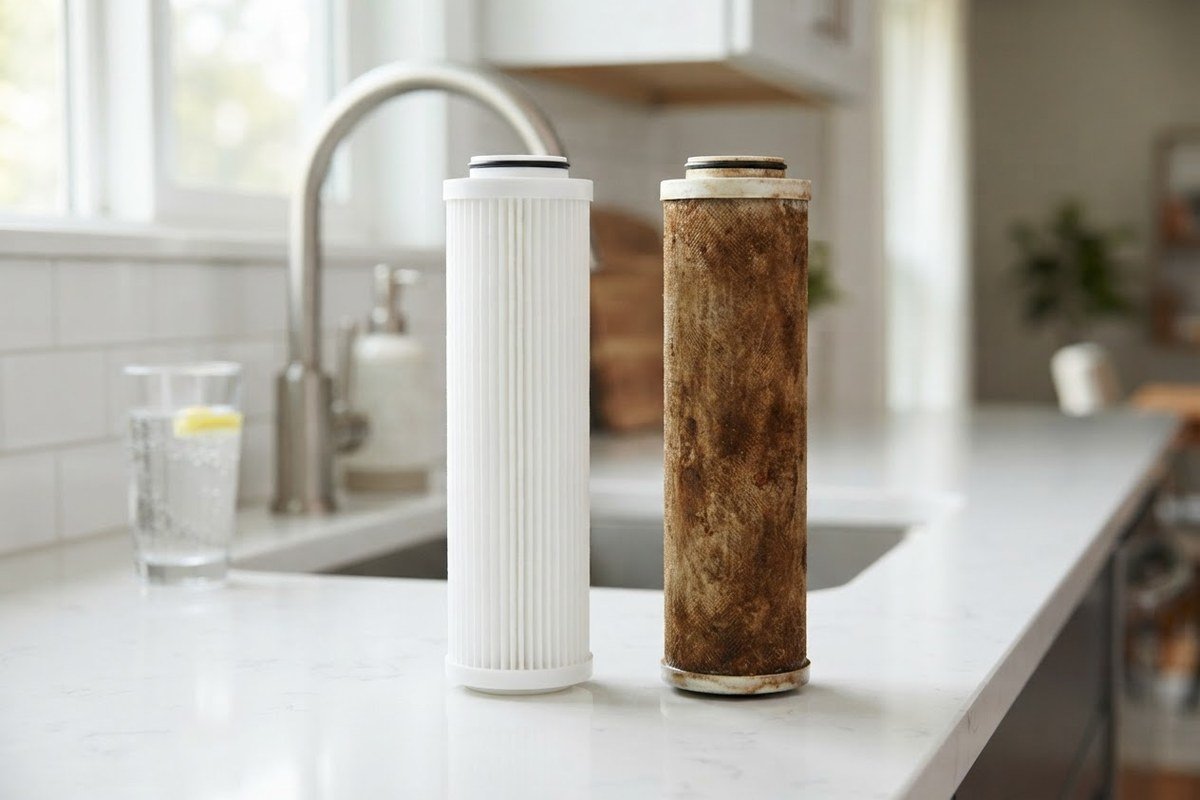
These are typical manufacturer ranges. Your specific model’s rated capacity always wins over any general figure.
If you are not sure which category your system falls into, our guide to the 4 types of water filtration systems sorts them out.
Myth: an old filter dumps everything it caught back into your water. This is the most common scare online, and the EPA’s guidance on granular activated carbon describes contaminants staying captured in the filter, with spent filters simply discarded in the trash. The realistic failure mode is not a sudden release — it is that the filter quietly stops reducing anything new. That is bad enough. It just is not the horror scenario.
Myth: if the water still tastes fine, the filter is still working. Taste tracks chlorine, and chlorine is one of the easiest things for carbon to handle. Lead, PFAS, and other health-relevant contaminants are tasteless at the concentrations that matter. A filter can taste perfect and be well past its certified capacity for the contaminant you actually bought it for. This is exactly why the rated capacity, not your palate, is the standard.
Three habits eliminate almost all of the friction:
If your current system is chewing through cartridges faster than it should, that is often a sizing problem rather than a maintenance one: an undersized filter on high-sediment water will always be expensive to run. Our water filter comparison covers matching system capacity to household demand, and the piece on the most important factors to compare when buying a water filter goes deeper on rated capacity and cost per gallon.
The most expensive mistake in home filtration is buying a system before you know what you’re removing. Start with a certified lab test to identify what’s actually in your water. Then match the system to the result — whole-house filtration for sediment, chlorine and hardness across every tap, or a point-of-use system if you only need better drinking water at the kitchen sink.
An unopened, dry cartridge in its sealed packaging stores well for a long time. An installed filter that has sat wet and unused is a different matter — that is precisely the damp, stagnant condition the CDC associates with germ growth in poorly maintained devices. If a system has been idle for weeks, replace the cartridge and flush the lines before drinking.
Yes. The CDC states that germs living in biofilms can grow and multiply in home water treatment devices that are not maintained and replaced according to manufacturer instructions. Most household filters are not designed to remove germs to begin with, which is why on-schedule replacement and occasional housing cleaning matter.
Six months is a common default, not a universal rule. What governs is your model’s rated capacity in gallons and your household’s usage. A single person on municipal water may comfortably reach the calendar limit; a family of five with an ice maker will hit the gallon limit well before it.
It stops being a certified filter. You lose the tested reduction performance, flow typically drops, and taste and odor return. Because carbon exhaustion is invisible, the water can look and taste normal while providing no verified protection against the contaminant you bought the filter to address.
Mostly it means you are drinking essentially unfiltered water while believing otherwise — which matters a great deal if you were filtering for lead or PFAS, and very little if you were filtering for taste. The genuine hygiene concern is a long-neglected wet cartridge, not a mildly overdue one.
Look for an NSF/ANSI 42 mark (aesthetic effects such as chlorine, taste, and odor) or NSF/ANSI 53 mark (health-related contaminants), and confirm the specific contaminant claim rather than assuming a general certification covers everything. Third-party universal cartridges vary widely; the certification mark and the stated contaminant list are what to check.
Replace on the rated capacity, treat flow drop and returning chlorine taste as early warnings, and do not let clear water talk you out of a change that is overdue. Filters are the rare household product whose failure mode is completely silent — which is exactly why the date on the box, and a marker on the cartridge, do more for your water quality than any amount of tasting and squinting at a glass.
Last updated September 3, 2026. This article is informational only and is not professional medical or plumbing advice. See our Health Disclaimer.
