
Beautiful Plants For Your Interior

Some links below are affiliate links. If you buy through them we may earn a commission at no extra cost to you. See our Affiliate Disclosure.
You can stay hydrated without drinking plain water by getting fluid from water-rich foods, milk, broth-based soups, unsweetened tea and coffee, and diluted juice. Food alone typically supplies about 20% of your total daily water intake, and beverages other than water supply most of the rest. Plain water is still the cheapest and lowest-calorie option, but if you dislike it or can’t keep it down, these alternatives genuinely count toward the roughly 2.7 to 3.7 liters of total water most adults need each day.
Some links below are affiliate links. If you buy through them we may earn a commission at no extra cost to you. See our Affiliate Disclosure.
Below is what the evidence actually supports, which foods carry the most water, and when “not drinking water” stops being a preference and becomes a medical problem.
The 2004 Institute of Medicine (now the National Academies) report on Dietary Reference Intakes for Water, Potassium, Sodium, Chloride, and Sulfate set an adequate intake of roughly 3.7 liters (125 oz) of total water per day for adult men and 2.7 liters (91 oz) for adult women. The critical word is total: that figure counts every drop you consume, including the moisture in food.
In the same report, the panel found that about 80% of total water intake comes from drinking water and other beverages, and about 20% comes from food. That 20% is an average across typical American eating patterns. Eat a diet heavy in produce, soups, and dairy and your share from food climbs; live on crackers and dry cereal and it falls.
So the honest answer to “can I skip water entirely?” is: you can shift a large portion of your intake to food and other drinks, but you cannot realistically hit 2.7 to 3.7 liters on food alone without eating an unusual volume of produce. Think of food as a supplement to fluid, not a replacement for it.
Water content varies enormously by food. Using values from USDA FoodData Central, these are the heavy hitters:
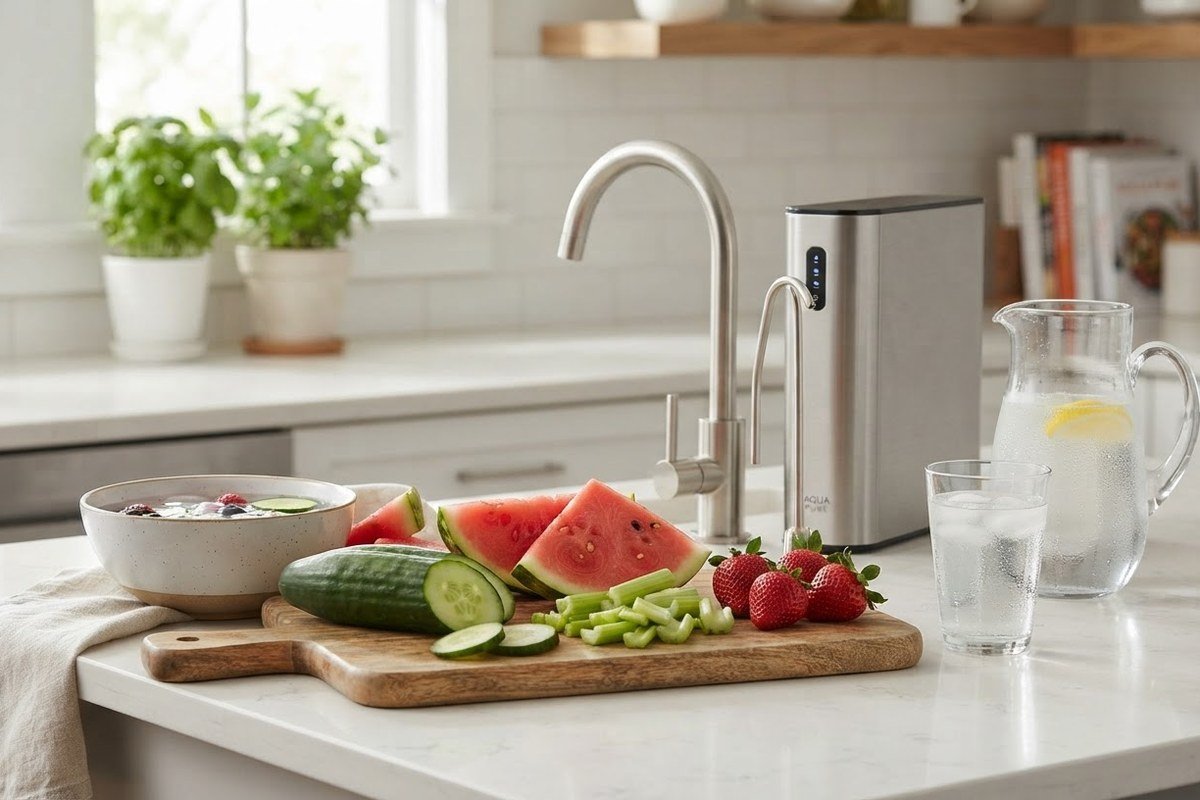
A practical rule: two cups of chopped high-water produce contributes roughly 8 ounces of fluid. Three or four servings a day meaningfully moves the needle, especially combined with soup or a smoothie.
The catch is that most of that water was filtered by the plant, but the water you add — to soup, coffee, smoothies, and the rinse water on your produce — comes straight from your tap. If your municipal supply has problems, cooking and food prep carry them into your food. That is worth checking against your state’s drinking water quality profile before you assume “I get my water from food” solves anything.
This is the finding most people find surprising. In a randomized trial published in the American Journal of Clinical Nutrition, Maughan and colleagues (2016) developed a beverage hydration index by measuring how much of 13 different drinks the body actually retained over four hours.
Compared with still water, participants produced about 25% less cumulative urine after drinking skim milk, full-fat milk, or an oral rehydration solution. The measured differences in urine output versus still water were 294 g for full-fat milk, 339 g for skim milk, and 362 g for the oral rehydration solution. In plain terms: the fluid stayed in the body longer.
The mechanism is not magic. Milk and rehydration solutions contain sodium, potassium, and a small amount of carbohydrate and protein, which slow gastric emptying and reduce how fast the kidneys dump the load. Plain water arrives fast, dilutes the blood, and triggers urination. That same logic is why electrolyte water outperforms plain water in specific situations — heavy sweating, illness, or GLP-1 side effects — but is unnecessary for ordinary daily hydration.
Per the CDC’s guidance on water and healthier drinks, milk, fortified unsweetened milk alternatives, limited amounts of 100% juice, plain coffee and tea, sparkling water, and seltzer all contribute fluid. Caffeinated coffee and tea count too — the mild diuretic effect at normal intakes does not cancel out the fluid they deliver.
What works against you: sugar-sweetened sodas and energy drinks add fluid but bring a large sugar load, and alcohol suppresses vasopressin and increases urine output enough that it is a net negative at moderate to high volumes.
Here is what covering roughly 2.7 liters looks like when you never pour a glass of water:
That totals roughly 2.4 to 2.5 liters — close, but you can see how much deliberate effort it takes, and how many calories come along for the ride. Most people find it easier to drink some water and use food to close the gap. If plain water is the problem, a fruit infuser bottle or a well-maintained filter pitcher often fixes the taste complaint that caused the aversion in the first place — and taste is the reason most people give. Our guide to the healthiest water to drink covers which options are worth the money.
There is a difference between preferring other beverages and being unable to take in fluid. The CDC notes that dehydration can cause unclear thinking, mood changes, overheating, constipation, and kidney stones. If nausea, vomiting, diarrhea, or a swallowing problem is why you are not drinking, food-based hydration will not keep up with the losses — that needs medical attention, not a produce strategy. During illness, an oral rehydration solution is the evidence-backed option, which is exactly what the beverage hydration index study found.
Also worth knowing: several conditions produce dehydration-like symptoms without actual fluid loss. We break those down in what can be mistaken for dehydration. For the broader picture on fluid needs, see our hydration and health guide.
If you’ve been increasing your water intake, it’s worth knowing what’s actually coming out of your tap. Your utility’s annual report covers the whole system average, not your house — and it says nothing at all about private wells or your own plumbing. A certified lab test gives you a full contaminant panel and, just as often, tells you your water is fine and you don’t need to buy anything.
Not sustainably for most people. Food supplies roughly 20% of typical total water intake, and reaching 2.7–3.7 liters from food alone would require an impractical volume of produce. Some populations with very high-moisture diets come closer, but it is not a reasonable plan for a standard Western diet.
No, not at ordinary intakes. Caffeine has a mild diuretic effect, but the fluid volume in a cup of coffee more than offsets it. The CDC lists plain coffee and tea among beverages that contribute to daily fluid intake.
By the measure used in the 2016 beverage hydration index study, yes — participants retained skim and full-fat milk better than still water, producing about 25% less urine over four hours. That does not make milk a better everyday choice for everyone, since it carries calories, but for rehydration after fluid loss the evidence favors it.
Yes. The 8-glasses figure was never an official recommendation to begin with. The actual guidance is a total-water target that explicitly includes moisture from food.
An oral rehydration solution or milk, both of which the beverage hydration index study showed are retained better than water. Broth-based soup is a reasonable food-based option because it delivers fluid plus sodium together.
Yes. Soup, coffee, tea, smoothies, cooking water, and produce rinsing all use your tap supply. Contaminants in that supply follow the water into your food. Check your local report and see our state-by-state water quality hub.
You can shift most of your hydration away from plain water using water-rich produce, milk, soup, and unsweetened tea or coffee — and in some cases those options are retained better than water. But food realistically covers around a fifth of your total needs, so “no water at all” means drinking something else in volume, not eating your way to hydration. If taste is the barrier, fix the water rather than abandoning it.
Last updated August 3, 2026.
This article is for general information only and is not medical advice. See our Health Disclaimer.
